
Introduction: The Massive Shift in Digital Marketing
Think back to how we did Search Engine Optimization (SEO) a few years ago. You just needed to pick a few keywords, write a long 2,000-word article, build standard backlinks, and wait for Google to rank your link on page one. It was simple, structured, and predictable.
But as we sit here in 2026, those traditional marketing playbooks are failing.
Modern internet users do not have the patience to click through multiple website links just to find a single piece of information. They expect quick, reliable, and crisp answers on their screens immediately. This sudden change in user behaviour is why smart brands are shifting their budget toward answer engine optimization.
Old SEO strategies are no longer enough to save your organic traffic from dropping. As platforms evolve, google ai search is becoming the primary tool that everyday internet users use to find products and solutions. In this detailed guide, the team at GrowSarrthi explains how this transition affects your brand and how you can optimize your website to stay ahead of the curve.
Section 1: What Exactly is Answer Engine Optimization?
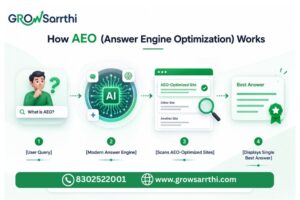
To protect your digital footprint today, you must master the mechanics of answer engine optimization. We define it as a specialized digital marketing method where you structure and format your web content so that modern discovery engines can scan it instantly, match it with user intent, and present it as the definitive response.
Traditional search platforms give people a long list of blue links to choose from. On the flip side, an answer engine reads the top pages on the web, extracts the vital data points, and builds a custom paragraph for the user. Whenever a query drops, the Google AI Search system scans the web to fetch highly credible, short insights. Therefore, the main goal of answer engine optimization is to make your original content the ultimate source for that generated box.
Why is This Essential for Your Business?
-
The Dominance of Zero-Click Searches: Studies show that over 60% of searches now end without a single click. Users get exactly what they need right on the results page, particularly when google ai Search creates live summary snapshots.
-
We are Asking Long Questions: Nobody types broken phrases like “Best digital marketing agency” anymore. Instead, consumers use full sentences like, “Can you tell me a good marketing agency in Jaipur that is budget-friendly and can help me increase my e-commerce sales?”
-
Multi-Modal Visual Search: Customers are now uploading pictures, using voice notes, and typing text all at once to discover local service providers.
Section 2: Technical Breakdown: Traditional SEO vs. Modern AEO
Does this mean traditional SEO is dead and gone? No, we do not believe so. Instead, answer engine optimization works as an advanced, hyper-focused extension of your existing SEO setup. When google ai search pulls data to answer a query, it actively looks for specific structural code markers.
To win online, you need to understand how these two frameworks compare:
| Optimization Factor | Traditional SEO Framework | Modern AEO Framework |
| Core Architecture | Crawler-based (Bots index entire web pages). | Context-based (Systems reading the underlying meaning). |
| Primary Metrics | Click-Through Rate (CTR), Impressions, Rank position. | Citation Share, Brand Mentions, Source Attribution. |
| Search Intent | Informational, Navigational, Transactional. | Conversational, Contextual, Direct Problem-Solving. |
| Content Unit | Long-form articles, landing pages, long blogs. | Semantic nodes, structured fragments, concise FAQs. |
| User Experience | Page speed, internal linking, website UI/UX. | Direct answer delivery, clear hierarchy, and fact accuracy. |
Chat with our Experts on WhatsApp
Section 3: How Modern Answer Engines Process Information
These new-age search platforms do not guess which website to feature. Every single day, millions of entrepreneurs watch how google ai search builds live text summaries for their customers. The system relies on three distinct pillars to pull this off:
1. Natural Language Processing (NLP)
Modern systems process the English language just like human beings do. They know that words like “cheap”, “low-cost”, and “budget-friendly” carry the exact same meaning. They analyze sentence patterns to find the user’s hidden pain point. This pattern is obvious when google ai Search answers questions with deep contextual understanding.
2. Knowledge Graphs
Giant search companies build and maintain massive internal Knowledge Graphs. These systems map connections among real-world entities—such as active businesses, geographic locations, and experts. If your brand does not show up as a verified entity here, the search bots will skip your pages.
3. Retrieval-Augmented Generation (RAG)
This is where the magic happens. When an online user asks something, the search platform finds real-time data from a tiny group of highly trusted websites. It processes those notes to craft an easy-to-read summary. Our primary objective under answer engine optimization is to make sure your website is the one chosen during that quick retrieval window.
Section 4: The 7-Step GrowSarrthi Blueprint to Rank in Direct Search Results
If you want these new platforms to display your business name as the definitive solution, you must execute this 7-step marketing blueprint:
Step 1: Use the “Inverted Pyramid” Writing Style
Modern engines do not like fluffy, long introductions that waste time. When a platform reads your text, it wants to see the main value point right away. Format your articles using this layout:
-
The Core Answer (Top Section): Write a 2-3 sentence direct response (roughly 40-60 words) that addresses the query instantly.
-
Supporting Data (Middle Section): Use clear bullet points, brief comparison tables, and quick lists to back up your statement.
-
Deep Context (Bottom Section): Add deep, long-form explanations for those readers who want to learn the entire background.
Step 2: Build Around Semantic and Entity Clusters
You must stop repeating old keywords over and over again. Stuffing keywords will get your site penalized. Instead, use natural variations and terms that belong to the same industry family. This approach helps you pass the strict filters that google ai Search uses to block spam pages.
-
For Example: If your core theme is “Email Marketing”, your copy must naturally talk about “Open Rates”, “Click-Through Rate (CTR)”, “Automation Workflows”, and “Subscriber Segmentation”.
Step 3: Write Clear and Error-Free Schema Code
Think of schema markup as an official digital ID card for your website data. It tells search crawlers exactly what your text means. To ensure your answer engine optimization campaigns bring real results, implement these specific schemas:
-
FAQPage Schema: Wrap your questions and answers in clean backend code.
-
Product & Review Schema: Systems scan this data to recommend local products to buyers.
-
Organization Schema: This clarifies your company’s name, verified founders, and physical office location.
Step 4: Earn Clean Digital PR and Mentions
Discovery engines do not just study your owned website; they track your reputation across the wider internet.
-
Your brand needs to appear on top-tier news sites, professional industry forums, and active community platforms.
-
When an engine looks for an answer and finds your brand name recommended across multiple third-party portals, it builds massive trust and ranks you higher.
Step 5: Focus on Real Conversational, Long-Tail Phrases
Pay attention to how people actually speak into their phones or how an AI answers questions directly on a small screen. They use natural, everyday human phrasing.
-
AEO Action Plan: Take those conversational questions and use them as your main subheadings (H2 or H3 tags) inside your blogs. This helps your site show up when an AI answers questions for consumers who are looking to buy a service immediately.
Step 6: Prove Your E-E-A-T (Expertise and Authority)
Search companies want to protect their users from fake news and incorrect calculations. Because of this, they only fetch summaries from proven experts.
-
Add an authentic Author Bio that highlights the writer’s actual industry experience and background.
-
Support your data by linking out to respected research papers, official government websites, or deep case studies.
Step 7: Keep Refreshing Your Core Content
Algorithms are hungry for fresh data. If your business guides are old or carry outdated numbers from two years ago, the system will drop your links.
-
Check your top blog posts every 3 to 6 months. Update them with new market statistics and current trends.
Section 5: Case Study: How GrowSarrthi Scaled an AI-First Authority Brand
Let us look at a real example from our agency records. A B2B software company partnered with GrowSarrthi because its search traffic was dropping fast. They were losing ground because traditional keyword positions were disappearing behind direct automated answer boxes. We saw that when an AI answers questions for their ideal customers, their competitors were walking away with all the visibility.
Our Strategic Execution:
-
The Deep Audit: We reviewed their entire site and found that their core answers were hidden at the bottom of long, confusing pages.
-
Content Restructuring: We wrote crisp “Quick Answer Boxes” (40-50 words) at the very top of their 50 most important pages to clean up their answer engine optimization score.
-
Schema Overhaul: We added custom, error-free JSON-LD schemas across all target service pages.
-
Community Footprint: We started high-value threads about their software use-cases on niche business forums so that discovery models could index their brand name.
The Business Outcome:
Within 90 days, our client’s organic traffic curve flattened out and stabilized. More importantly, their pages started showing up prominently when an AI answers questions about business software. Their brand citations in automated boxes jumped by 320%, bringing in a 45% increase in highly qualified business leads.
Section 6: Common AEO Mistakes Every Business Must Avoid
When you build out an answer engine optimization blueprint, make sure you stay far away from these common errors:
-
Publishing Fluffy Paragraphs: Discover bots hate text that does not get to the point. If you write long, empty filler sentences, the bots will jump to someone else’s page. This happens all the time when an AI answers questions using data from tighter, cleaner competitor sites.
-
Skipping Technical Markups: Writing plain text works for humans, but machines read code. If you do not include clear schema tags, your pages will miss out on direct answer placements.
-
Using Unverified Claims: If you publish fake data or unverified numbers, search platforms will flag your domain as unsafe, killing your rankings.
-
Ignoring Search Intent: If a consumer wants an educational tutorial and you show them a sales-heavy product page, the algorithms will ignore you.
Section 7: Future Trends: What to Expect Next
As we look at the coming months, the connection between your website and modern search networks will grow even deeper. We will see systems where an AI answers questions using live video snippets and audio files, rather than just plain text lines.
At the same time, google ai search layouts are changing every week to offer a better user experience. This means businesses that implement answer engine optimization today will secure a permanent, long-term advantage over everyone else in their market.
Conclusion: Future-Proof Your Business with GrowSarrthi
Setting up an answer engine optimization roadmap is not a luxury project you can push to next year. It is a vital business requirement today. Search engines are changing from simple link directories into active digital advisors. When an AI answers questions for your prospective clients, your company needs to supply the core data. If your business content does not show up as the source, your online presence will simply fade away.
Do not let your competitors leave you behind in this new marketing era.
At GrowSarrthi, we have a dedicated team of digital optimization specialists, data analysts, and content strategists. We do not just focus on traditional search pages; we build your website into the default answer for your entire niche. From technical schema coding to clean text layouts, we take care of everything.
Is your company ready to dominate the next era of online search?
Take action right now. Book an exclusive 1-on-1 Strategy Session with the team at GrowSarrthi and pull miles ahead of your competition.
👉 Click Here to Book Your Free AEO Consultation Session with GrowSarrthi!
Quick Answers to Common Questions
Q1. What is Answer Engine Optimization?
Answer Engine Optimization is the process of structuring and formatting your web content so that modern search engines can instantly scan it, understand its meaning, and present it as the single best answer to a user’s query — instead of just showing it as one of many links.
Q2. How is Answer Engine Optimization different from SEO?
Traditional SEO focuses on ranking your page higher in a list of search results. Answer Engine Optimization goes one step further — it makes your content the direct answer that search engines display at the very top, so users get what they need without clicking any link at all.
Q3. Why is Answer Engine Optimization important in 2026?
User behavior has changed dramatically. Over 60% of searches now end without a single click because people get their answers directly on the results page. If your content is not optimized for this format, your competitors will take that visibility and you will keep losing organic traffic.
Q4. How do I start with Answer Engine Optimization?
Start by placing a clear 40–60 word direct answer at the very top of your blog post. Then add FAQ schema markup to your page, use real conversational questions as your H2 and H3 headings, and make sure your content is accurate, well-structured, and easy to read.
Q5. Can small businesses benefit from Answer Engine Optimization?
Absolutely. Answer Engine Optimization is not just for big brands with large budgets. Any business — big or small — can appear as a featured answer if their content is clear, accurate, and properly structured. In fact, it levels the playing field and gives smaller brands a real chance to compete.