
You set up the PPC campaign yourself. Decided the budget, wrote the headlines, picked the keywords, and hit publish. In the first few days, clicks started coming in. You kept refreshing the dashboard. But leads? Nothing. No calls. No form fills. No WhatsApp pings. Just money going out, silence coming back.
Honestly, this is not a rare story. We speak to business owners in Jaipur almost every week who have been exactly here. Some spent Rs. 15,000. Some crossed Rs. 1.5 lakh. The amount is different but the reason is almost always the same — it is not that Google Ads does not work, it is that the PPC campaign was set up in a way that was never going to produce results in the first place.
We have been running pay per click advertising campaigns for businesses across Jaipur for a while now. We have seen the inside of a lot of ad accounts. And the same five mistakes show up again and again. This blog goes through each one, explains why it kills your PPC campaign, and tells you what to actually do about it.
Whether you are handling your own google ppc advertising management or paying someone else to do it, these five points are worth reading carefully. Because if even two or three of them are present in your current PPC campaign, that is your answer.
Mistake 1: You Are Targeting Keywords That Were Never Going to Convert
There is a real difference between keywords that get clicks and keywords that bring in paying customers. Most businesses, when they first set up a Google PPC AdWords campaign, go for terms that feel relevant — broad, popular searches like “digital marketing agency” or “PPC services India.” The problem is that the people typing these are usually at the very start of their research. Comparing options. Reading blogs. Not ready to hire anyone yet.
And you are paying for every single one of those clicks.
There is also the match type problem. Most people new to google ppc advertising management default to Broad Match, which means Google can show your ad for searches that are only loosely connected to your keyword. You target “PPC management services” and end up showing to someone who searched “PPC course for beginners.” That person is not your customer, but you paid for the click.
Then there is the negative keyword issue. Negative keywords are the list of terms you tell Google to never show your ad for. Most beginners never build this list at all. Without it, the budget bleeds out on irrelevant traffic every single day, quietly, without any obvious alarm going off.
How to fix it:
- Drop Broad Match. For keywords that clearly indicate purchase intent, use ‘Phrase Match’ and ‘Exact Match’.
- Instead of just “advertising agency,” target specific phrases such as “pay per click advertising agency in Jaipur.”
- Prepare your ‘Negative Keyword’ list before the campaign begins—not afterwards.
- Check your Search Terms Report every fortnight and keep adding irrelevant terms to your negatives
- Keep ad groups tight — one theme per group, not a loose mix of related terms
Mistake 2: You Are Sending Paid Traffic to the Wrong Page
This one is avoidable, and it costs a lot. A business will set up a decent Google PPC AdWords campaign — reasonable keywords, decent bids, proper targeting — and then send every single click straight to their homepage.
The homepage is not built for this. It is designed to introduce your whole business to someone who knows nothing about you. Multiple navigation links, different service sections, and a contact form buried somewhere at the bottom. When someone lands there after clicking a specific ad, they have to figure out on their own where to go next. Most of them do not bother. They leave in 10 to 15 seconds, and you have already paid for that click.
We worked with a real estate business in Jaipur that had a Rs. 50,000 monthly budget. Around 400 clicks a month, 5 to 6 leads. Just over 1% conversion rate. After we built them one dedicated landing page — matched to the exact ad message, WhatsApp button above the fold, fast on mobile, three client testimonials visible without scrolling — the same budget started producing 28 to 32 leads a month. Same keywords. Same spend. Just a better page.
The ad gets people to click. The landing page is where the PPC campaign actually wins or loses.
What your landing page must have:
- A headline that directly mirrors your ad — if the ad said “PPC Company Jaipur,” those words need to appear on the page
- One clear call to action above the fold — one button, one goal, nothing competing with it
- Mobile load speed under 3 seconds — that is where most of your traffic is coming from
- Real proof — client names, actual results, Google review screenshots — not generic claims
- No header navigation that lets visitors wander off to other parts of your site
Build a separate landing page for each ad group. If you are running one campaign for “Google Ads management” and another for “Meta Ads management,” each needs its own page. This also improves your Quality Score, which pulls your cost per click down over time.
Mistake 3: Your Bidding Strategy and Budget Are Working Against Each Other
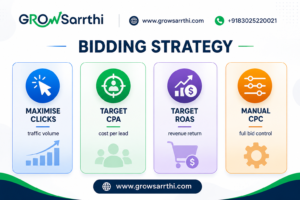
Google PPC AdWords has multiple bidding strategies, and choosing the wrong one for where your campaign currently stands can slowly kill everything. The most common version of this mistake is selecting “Maximise Clicks” and leaving it there for months. It is fine early on when you just need data. But as a long-term lead generation strategy, it does not work — it optimises for volume, not quality. You end up with cheap, irrelevant clicks that go nowhere.
The other side is the budget. We regularly see businesses in Jaipur running pay per click campaigns with daily budgets of Rs. 100 to Rs. 150 in industries where each click costs Rs. 80 to Rs. 120. That is one or two clicks a day. Google’s algorithm needs volume to learn — smart bidding strategies need at least 30 to 50 conversions per month before they start making intelligent decisions. With one click a day, you never get there. The campaign stays in a permanent learning phase, and nothing ever improves.
A reasonable rule for ppc management services: your daily budget should allow at least 10 to 15 clicks per day. Below that, you are not running a PPC campaign — you are endlessly testing the water without ever jumping in.
Bidding strategy — when to use what:
| Strategy | Use it when | It optimises for |
|---|---|---|
| Maximise Clicks | New campaign, first 3 to 4 weeks | Traffic volume |
| Target CPA | You have 50+ conversions recorded | Cost per lead |
| Target ROAS | E-commerce purchases are tracked | Revenue return |
| Manual CPC | Tight budget, hands-on manager | Full bid control |
Start with Maximise Clicks, collect a few weeks of conversion data, then shift to Target CPA. That is the standard process for a well-run pay per click campaign — it is how you move from spending money to actually investing it.
Mistake 4: Your Ad Copy Sounds Like Everyone Else’s and You Are Not Testing Anything
Search for any competitive service in Jaipur on Google right now. Look at the ads. Most of them say roughly the same thing. “Best Agency in Jaipur.” “Affordable Prices.” “Call Us Today.” “Trusted Experts.” After reading three or four of these, they all blur together. Users stop reading ads entirely and go straight to organic results — this is called banner blindness, and it is very real.
If your Google PPC AdWords ad looks and sounds like every other ad in your category, it will get ignored. Ignored ads mean you are paying for impressions that never become clicks, which damages your Quality Score, which raises your cost per click. It slowly makes things worse.
The second part of this mistake is not testing at all. Most businesses write one ad, leave it running for months, and assume the results are just how things are. But ad copy is one of the biggest levers in a pay per click campaign. The right headline can double your click-through rate. The wrong one can cut it in half. You will not know which is which without testing.
At GrowSarrthi, google ppc advertising management always includes monthly copy testing. We write two or three variations per ad group, run them against each other, and after enough impressions, pause the weaker ones. That is how performance improves over time without touching the budget.
How to write ads that actually get clicked:
- Put your main keyword in at least one of your three headlines
- Be specific — “Managed Rs. 2 Crore+ in Ad Spend” says far more than “Experienced Team
- Speak to the reader’s fear, not just their aspiration — “Stop Wasting Your Ad Budget” lands harder than “Get More Leads”
- Make your CTA direct — “WhatsApp for a Free Audit This Week” beats “Contact Us”
- Run at least two variations per ad group simultaneously
- After 400 to 500 impressions per variation, check which one is winning and pause the other
Google Responsive Search Ads allow up to 15 headlines and 4 descriptions. Use all of them. Make each headline different enough that Google has real options to test — not 15 versions of the same sentence.
Mistake 5: You Have No Idea What Is Actually Converting
This is the mistake that makes all the others impossible to fix. Without proper conversion tracking in your google ppc advertising management, you are operating completely blind. You do not know which keyword brought in a lead. You do not know which ad, which device, which city, or which time of day performed. You are spending money daily with no reliable way of knowing what is working.
We see this constantly. A business owner opens their Google Ads dashboard and says the campaign is doing well because they can see 300 clicks and 12,000 impressions. But when we ask how many leads actually came in, they are not sure. They think they got a few calls. They are pretty sure someone filled out the form. That is not marketing. That is just hoping for the best.
Any properly run ppc management service setup starts with conversion tracking. Before a single rupee goes into ads, the tracking should already be in place and verified. Every form submission, phone call, WhatsApp click, thank you page visit — all of it needs to be tied back to the specific keyword and ad that drove it. That data tells you where to put more budget and where to cut.
If your current pay per click advertising agency is not showing you a monthly report with cost per lead, number of leads, and conversion rate by keyword — ask them why. Those numbers should be the centrepiece of every performance conversation.
What you must be tracking:
- Contact form submissions — tied to the exact keyword and ad
- Phone calls — set up Google’s call reporting and a tracking number if possible
- WhatsApp clicks — every click on a WhatsApp button is a conversion signal, track each one
- Thank You page — redirect all form submissions to a standalone thank you page and track that URL
- Any bookings, purchases, or quote requests on your site
How to set it up:
- Google Ads — Tools — Conversions — create a new action for each type above
- Use Google Tag Manager to deploy tags without repeatedly editing your site’s code
- Connect Google Analytics 4 to your Google Ads account for deeper behaviour data
- Assign a value to each conversion so you can calculate actual ROI, not just count leads
All Five Mistakes Together
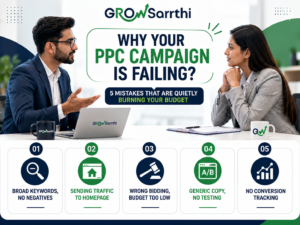
| # | Common PPC Campaign Errors | Their Solution |
|---|---|---|
| 1 | Broad keywords, no negatives | Long-tail + Exact/Phrase Match + negative keyword list from day one |
| 2 | Sending traffic to the homepage | Dedicated landing page per ad group, fast, mobile-friendly, one CTA |
| 3 | Wrong bidding, budget too low | Start Maximise Clicks, shift to Target CPA after conversion data builds |
| 4 | Generic copy, no testing | Specific headlines, keyword in title, A/B test every month |
| 5 | No conversion tracking | Full setup via Google Tag Manager + GA4 before campaign launch |
Conclusion
None of these five mistakes is unsolvable. Wrong keywords, a weak landing page, a mismatched bidding strategy, generic untested ad copy, and missing conversion tracking — every one of these has a clear and practical fix. The reason they persist is usually not ignorance. It is that pay per click advertising looks simpler than it is from the outside, and the problems are not always obvious until you know what to look for.
Google PPC AdWords works. It works well when someone who understands the platform is running it and paying attention consistently. The businesses in Jaipur generate 20, 30, 40 leads a month from paid search. There is nothing special about what they are doing. They are just avoiding these five mistakes and making small improvements every single week.
If you recognised your own PPC campaign anywhere in this blog, that is actually a good sign. It means the problem is identifiable and fixable. Start with whichever mistake is most obvious in your setup and work through from there.
Not getting the results you expected from your PPC campaign?
GrowSarrthi offers a free Google Ads audit for businesses in Jaipur. We go through your account, identify exactly what is not working, and tell you how to fix it — with no obligation to hire us afterwards.
You Ask, We Answer
Q1. What is a realistic minimum budget for a pay per click campaign in Jaipur?
For most local businesses, Rs. 15,000 to Rs. 25,000 per month is a practical starting budget. Industries like real estate, education, and healthcare typically require Rs. 30,000+ per click because clicks are more expensive. A good PPC company can recommend a more appropriate budget based on your goals and keywords.
Q2. Should I manage Google PPC AdWords myself or hire someone?
If you cannot monitor campaigns regularly, hiring a professional is usually the better option. Small mistakes in bidding, targeting, or tracking can waste more money than the management fee itself. A skilled PPC manager can improve results and reduce wasted spend.
Q3. How quickly will I see results from a pay per click advertising agency?
Traffic and leads can start coming within the first few days. But proper optimisation usually takes 3 to 4 weeks of data. For steady and predictable results, expect a 2- to 3-month growth period.
Q4. What does proper PPC management services actually include?
Good PPC management includes keyword research, ad copy testing, bid adjustments, negative keywords, conversion tracking, landing page suggestions, and monthly performance reports focused on leads and cost per lead.
Q5. PPC or SEO — which should a new Jaipur business focus on first?
PPC is better for quick visibility and immediate leads. SEO takes longer but helps build long-term traffic. For new businesses, starting with PPC while gradually building SEO is often the best approach.